Kelowna
Living Wage for Families BC has published the hourly wages required to enjoy a modest life in British Columbia.
Living Wage is defined as “the hourly rate at which a household can meet its basic needs once government transfers have been added to the family’s income (such as federal and provincial child benefits) and deductions have been subtracted (such as income taxes and Employment Insurance premiums).”
Living Wage for Families BC
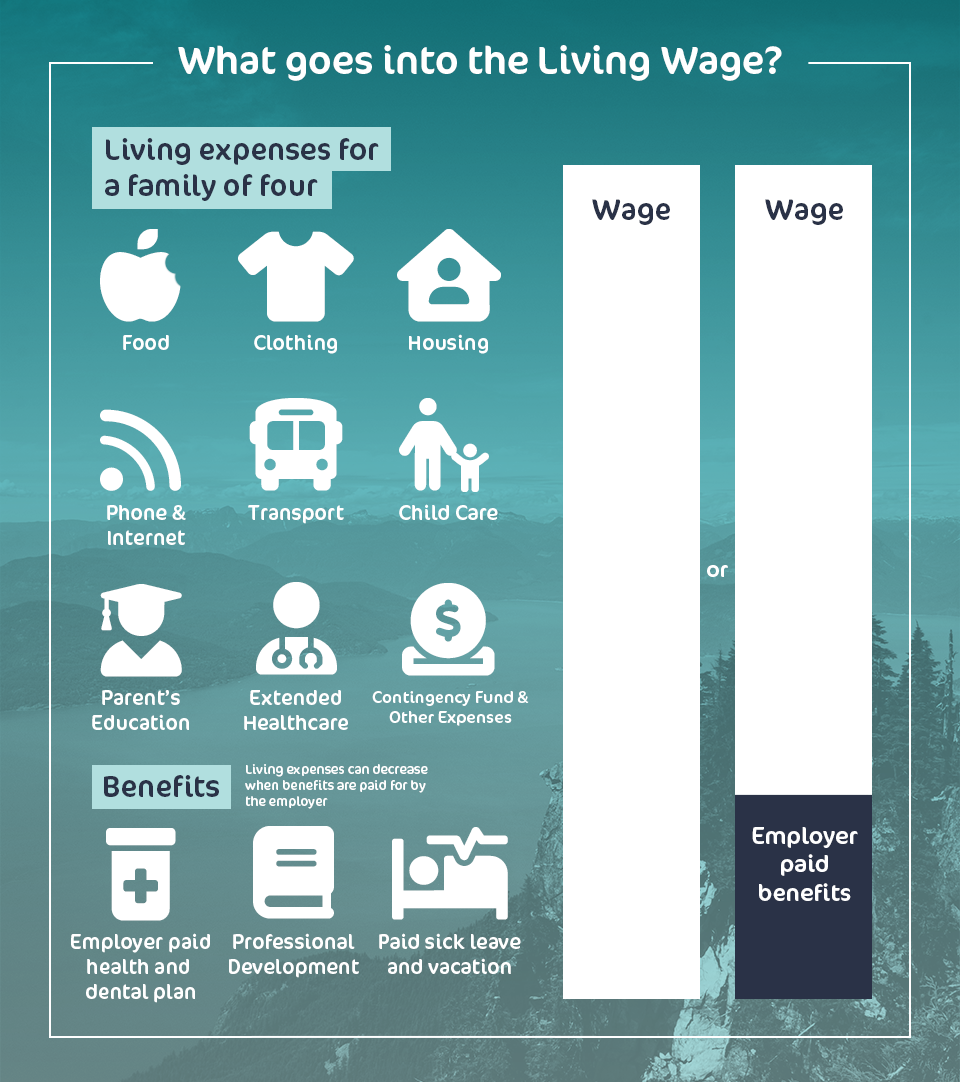
Living Wage in BC is calculated by adding expenses in 10 categories – food, clothing and footwear, shelter, phone and internet, transportation, other household and social participation expenses, child care, non-MSP health expenses, parent education and a contingency amount – for a typical family of two parents with two children aged four and seven with both adults working full time, 35 hours per week. Government benefits like federal and provincial child benefits is added and income taxes and Employment Insurance premiums are subtracted to arrive at the living wage calculation.
The living wage calculation does not cover credit cards, loans or other debt/interest payments, savings for retirement, owning a home, savings for children’s future education, anything beyond minimal recreation, entertainment or holiday costs, costs of caring for a disabled, seriously ill or elderly family member, and a large cushion for emergencies or tough times.
You may like:
British Columbia Living Wages 2022
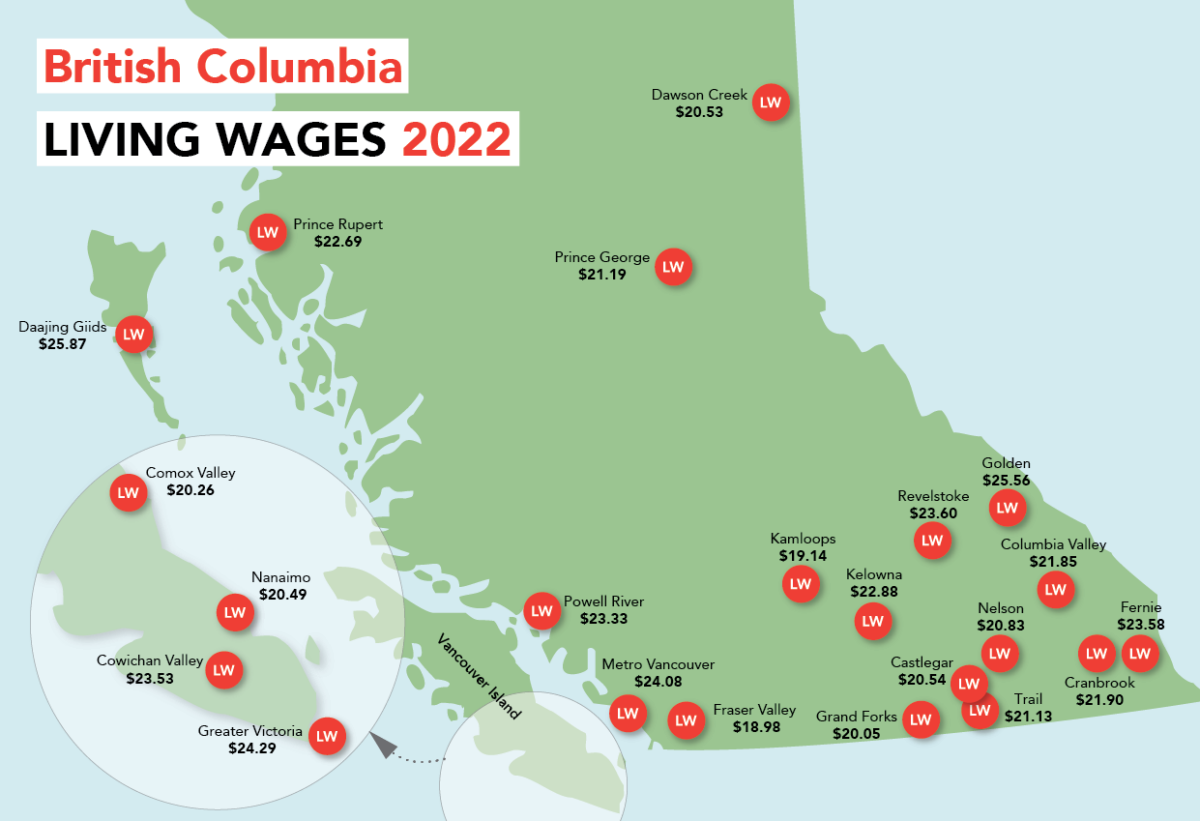
Living Wage for Families BC calculates Living Wage for 22 regions in BC.
This year’s living wage varies from $18.98 in Fraser Valley to $24.29 in Greater Victoria. The 2022 living wage for Metro Vancouver is $24.08 per hour. This is the first time Victoria’s living wage is higher than Metro Vancouver’s. The organization attributes this to the increased cost of food on Vancouver Island.
Living Wage for Families BC
- Castlegar — $20.54
- Columbia Valley — $21.85
- Comox Valley — $20.26
- Cowichan Valley — $23.53
- Cranbrook — $21.90
- Dawson Creek — $20.53
- Fernie — $23.58
- Fraser Valley — $18.98
- Golden — $25.56
- Grand Forks — $20.05
- Greater Victoria — $24.29
- Haida Gwaii — $25.87
- Kamloops — $19.14
- Kelowna — $22.88
- Metro-Vancouver — $24.08
- Nanaimo — $20.49
- Nelson — $20.83
- Powell River — $23.33
- Prince George — $21.19
- Prince Rupert — $22.69
- Revelstoke — $23.60
- Trail — $21.13
The rising inflation has caused the living wage to increase by 23.7 per cent in Kelowna, 18.7 per cent in Victoria and 17.3 per cent in Metro Vancouver from last year.
Living Wage for Families BC
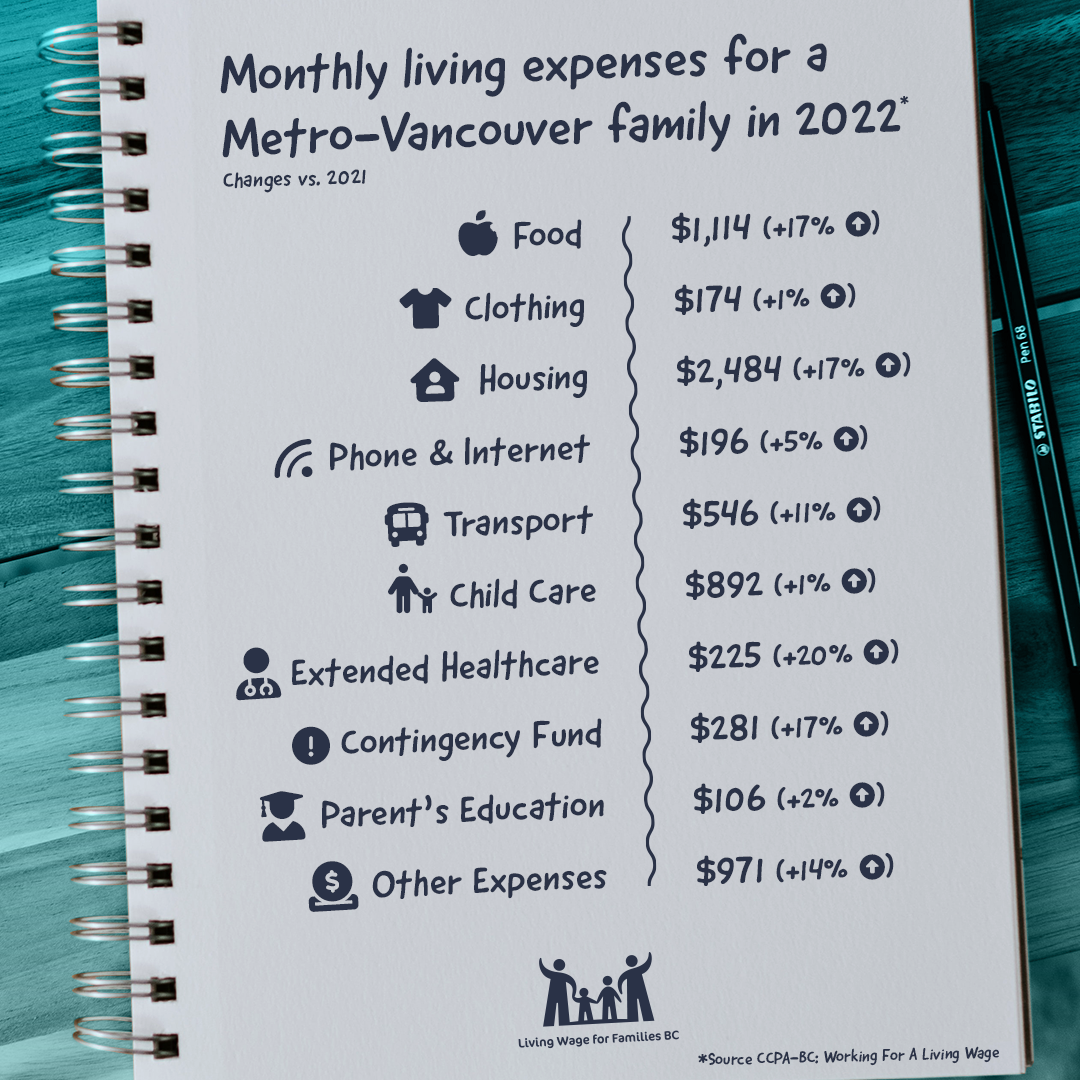
In the report, Living Wage BC has also described a typical monthly budget or what a two-parent family with two young children could afford on a 2022 living wage of $24.08 per hour in Metro Vancouver. The organization says this works out to $43,826 for each parent annually. The expenses work out to $6,989 per month for a 4-person family.
The living wage in B.C is much higher than the minimum wage ($15.65 per hour) but the organization says further increases in government benefits and investments, like $10-a-day child care and employers committing to pay living wages, can help make life affordable for families.
The detailed report including the spreadsheet calculation is available here.