 Calgary
The Canadian Automobile Association (CAA) has conducted a winter performance study on electric vehicles (EVs), testing their driving range and charging efficiency in sub-zero conditions.
Credit: Roberto Nickson/Pexels
The study involved 14 EV models, including seven of the top-selling vehicles in Canada, driven from Ottawa to Mont Tremblant in temperatures ranging from -7 to -15 degrees Celsius.
EV Range Reduction During Canadian Winters
This EV range test evaluates the actual driving range of various electric vehicles in winter conditions compared to their official NRCan ratings. The results showed a significant drop in driving range due to cold weather, with EVs losing between 14 and 39 percent of their officially rated range.
The Chevrolet Silverado EV ranked first, achieving the longest range at 456 km, though it still fell 14% below its official 724 km rating. The Tesla Model 3 followed with 410 km but was 30% lower than its 584 km official range. The Polestar 2 ranked third, driving 384 km, 14% below its 444 km rating.
On the lower end, the Volvo XC40 Recharge had the worst performance, covering only 248 km, a 39% drop from its 409 km official range. The Toyota bZ4X also struggled, achieving 255 km, 37% lower than expected. The Hyundai IONIQ 5 had a similar drop, reaching 262 km, 36% below its 410 km rating.
The Ford F-150 Lightning experienced one of the steepest declines, achieving only 296 km, 35% lower than its 515 km rating.
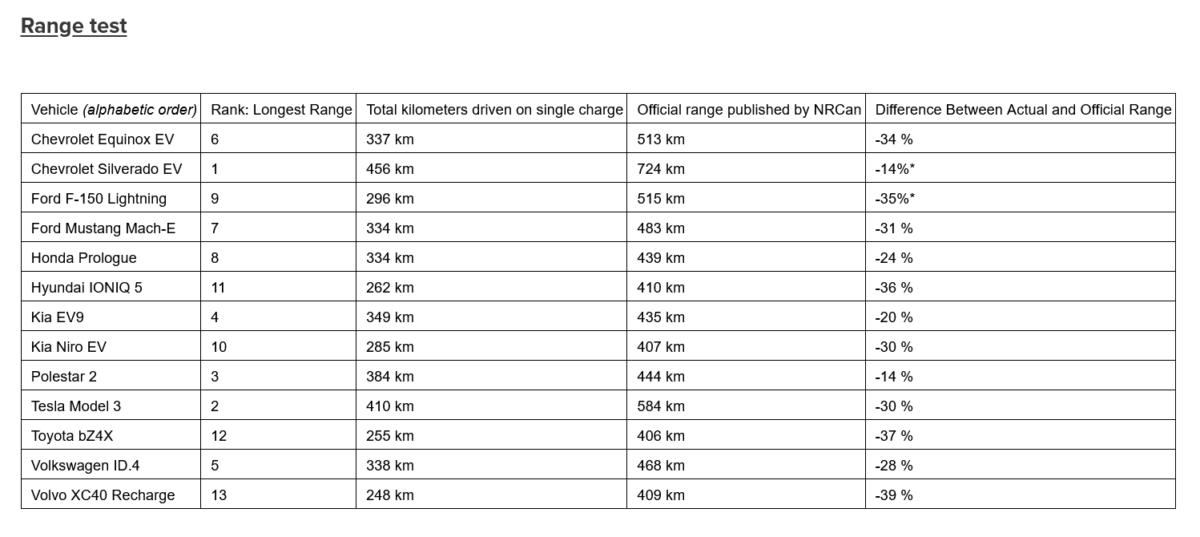
The calculation was adjusted to reflect that the Chevrolet Silverado EV started at 73% state of charge and that the Ford F-150 Lightning started at 89% state of charge. Note: due to a complication Kia EV6 did not participate in the range test/Credit: CAA
Speed of EV Charging
CAA’s test also examined charging speeds, a major concern for long-distance EV travel. Each vehicle was connected to a DC fast-charger for 15 minutes to determine how much range could be added. On average, EVs gained about 100 kilometres, equating to 28 percent battery charge.
This charge test compares electric vehicles on charging speed, ranking them by the kilometers gained in 15 minutes and time taken to charge from 10% to 80%.
The Tesla Model 3 ranked first, adding 205 km in 15 minutes and completing the charge in 37 minutes, with an average charging speed of 96 kW. The Chevrolet Silverado EV followed closely, adding 199 km in 15 minutes but taking 42 minutes to reach 80%, boasting the highest average charging speed of 233 kW. The Chevrolet Equinox EV came in third, adding 131 km in 15 minutes and 42-minute total charge time to reach 80%.
Other notable performers included the Volkswagen ID.4 (112 km in 15 minutes, 34-minute charge) and Polestar 2 (120 km, 40-minute charge). The Kia EV9 had the fastest overall charge time at 33 minutes, adding 105 km in 15 minutes.
On the lower end, the Toyota bZ4X performed the worst, adding only 19 km in 15 minutes and taking 92 minutes to charge. The Kia Niro EV also struggled, adding 35 km in 15 minutes and 77 minutes to reach 80%.
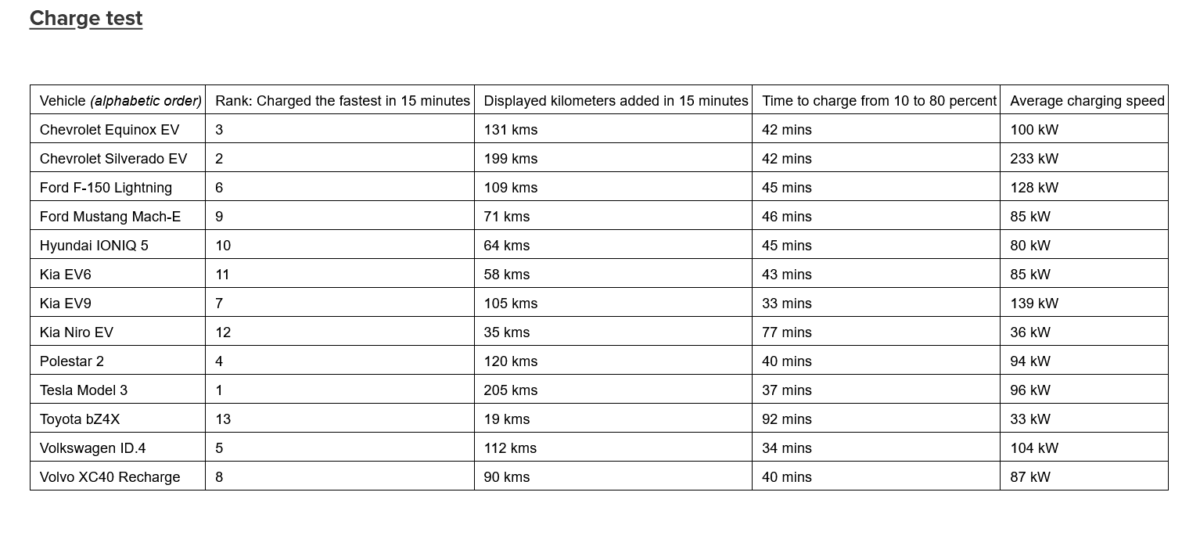
Honda Prologue was not included in the charge test as it encountered an error and data was unavailable. All vehicles were charged using 350 kW chargers, while the Tesla was charged at 150 kW due to compatibility requirements with the non-Tesla adapter./Credit: CAA
Survey data from CAA indicated that 65 percent of Canadian EV owners have noticed reduced range in cold weather, and 53 percent still prefer using a gas-powered vehicle for long winter trips. Additionally, 40 percent of EV owners reported significantly slower charging in extreme cold.
CAA is advocating for a standardized Canadian labelling system that includes winter-specific range estimates rather than a single average.
According to CAA, the following tips will maximize EV performance in cold weather and optimize efficiency, ensuring better performance and safety during winter driving:
- Precondition the EV by warming it while plugged in before driving to improve range and comfort.
- Clear snow and ice to reduce weight and drag, which extends range and enhances safety.
- Use heated seats instead of cabin heaters to conserve battery power.
- Park indoors or in a sheltered area to keep the battery warm, improving range and charging speed. If indoor parking isn’t an option, park in direct sunlight when possible.
The report is based on a survey of 16,041 EV owners across all provinces from October 3 to 22, 2024, in collaboration with PlugShare Research. General population findings are based on a separate poll of 2,880 Canadians from September 13 to 21, 2024, with a margin of error of ±1.9%.
The report is available here. Information about the price and performance of electric vehicles is available in CAA’s EV Buyer’s Guide.


On the phone I can’t see the table. And can’t zoom it. So annoying.