Kelowna
Canada is preparing a long-term overhaul of its electricity system, with Prime Minister Mark Carney announcing plans for a National Electricity Strategy aimed at doubling grid capacity by 2050.
The announcement comes as electricity demand is expected to surge. Globally, about CAD $3.1 trillion is already spent each year on grids, efficiency, and electrification, more than double the CAD $1.5 trillion directed toward conventional fuels. By mid-century, demand could rise between 78 and 102 percent, reflecting shifts toward electrification and industrial growth.
In Canada, that pressure is expected to be just as pronounced. Demand could double by 2050, driven by sectors such as critical minerals, battery manufacturing, electric vehicles, and housing construction. Meeting that need may require more than $1 trillion in infrastructure investment.
The federal government says the country is starting from a relatively strong position, with about 80 percent of its electricity already coming from non-emitting sources. The country has the lowest-cost residential electricity in the G7 and the fourth lowest in the Organization for Economic Co-operation and Development. Industrial power costs rank second lowest in both groups, while Canada also holds the second-highest share of non-emitting electricity in the G7 and third in the G20.
The strategy also outlines a continued role for natural gas within the electricity mix. Gas-fired generation is described as supporting reliability and flexibility, particularly in regions such as Western Canada, where it can complement intermittent sources like wind and solar. Its ability to start quickly and adjust output in real time allows it to meet peak demand, stabilize the system during low renewable output, and contribute to baseload supply.
Per the report, Canada’s natural gas has relatively low emissions intensity, with further reductions expected through methane abatement technologies. It also points to domestic supply as a factor in energy security, helping limit exposure to global disruptions while keeping costs stable.
Beyond infrastructure, the plan ties electricity supply to economic growth. Sectors such as artificial intelligence data centres, liquefied natural gas exports, mining, and advanced manufacturing are expected to drive new demand. Access to reliable, affordable power is increasingly seen as a deciding factor in attracting these investments, with jurisdictions competing to bring new capacity online quickly.
At its core, the plan is built around four priorities:
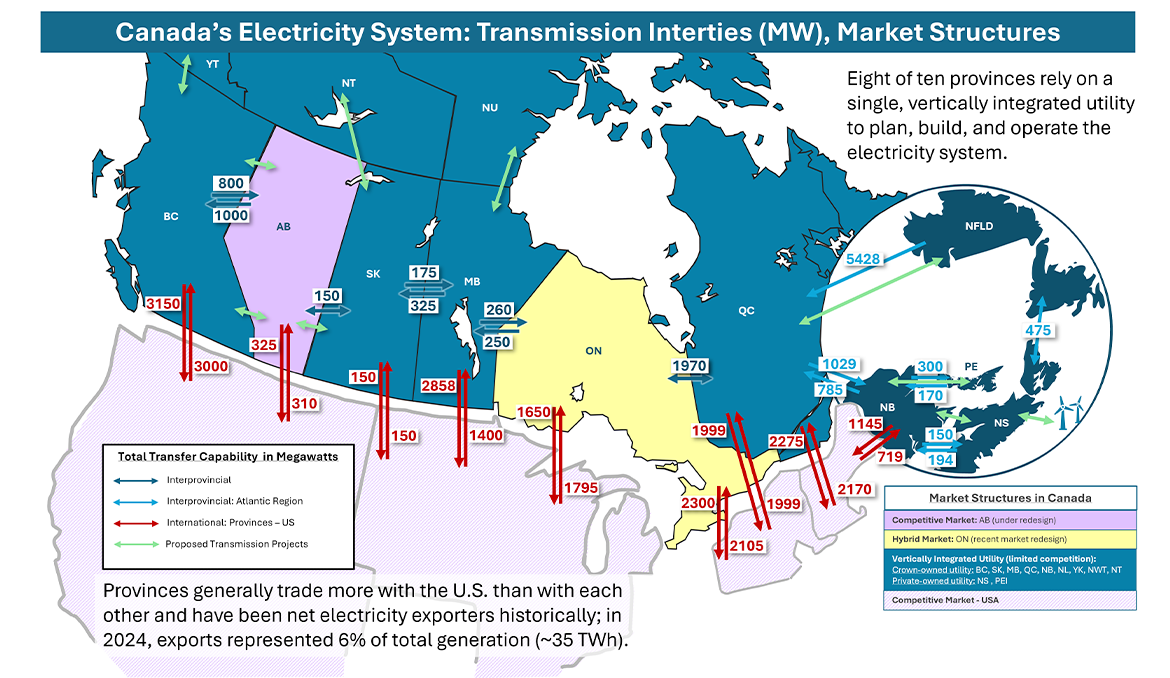
Map of existing and proposed interties, and Canada-U.S. transmission (2025)/Credit: Natural Resources Canada
- Expanding electricity infrastructure
The plan focuses on large investments in generation, transmission, storage, and modernization to double grid capacity while spreading costs over time to maintain affordability and reliability nationwide. - Connecting regional grids
Canada’s fragmented electricity systems will be linked through new transmission lines, reducing outages and inefficiencies while improving reliability and making better use of existing power across provinces and territories. Specific examples highlight what greater integration could deliver. Expanding the interconnection between British Columbia and Alberta could yield about $1.7 billion in net benefits by 2050. Tripling capacity between Manitoba and Saskatchewan could generate $2.3 billion. A broader $1.7 billion investment in interprovincial transmission is also projected to unlock $6.6 billion in private funding and up to $92.5 billion for renewable power over ten years.
- Developing a skilled workforce
More than 130,000 workers will be needed by 2050, prompting efforts to train, attract, and retain talent required to build, operate, and maintain an expanded and modernized electricity system. - Boosting domestic manufacturing
The strategy includes growing Canadian production of energy technologies and components, aiming to strengthen supply chains and ensure more of the equipment powering the grid is made domestically.
Consultations are now underway with provinces, territories, Indigenous communities, utilities, and labour groups. The government estimates the strategy could deliver up to $15 billion in energy savings and lower costs for seven in ten households.