 Toronto
Ontario Premier Doug Ford today announced a series of retaliatory measures against the United States in response to tariffs imposed by President Donald Trump.
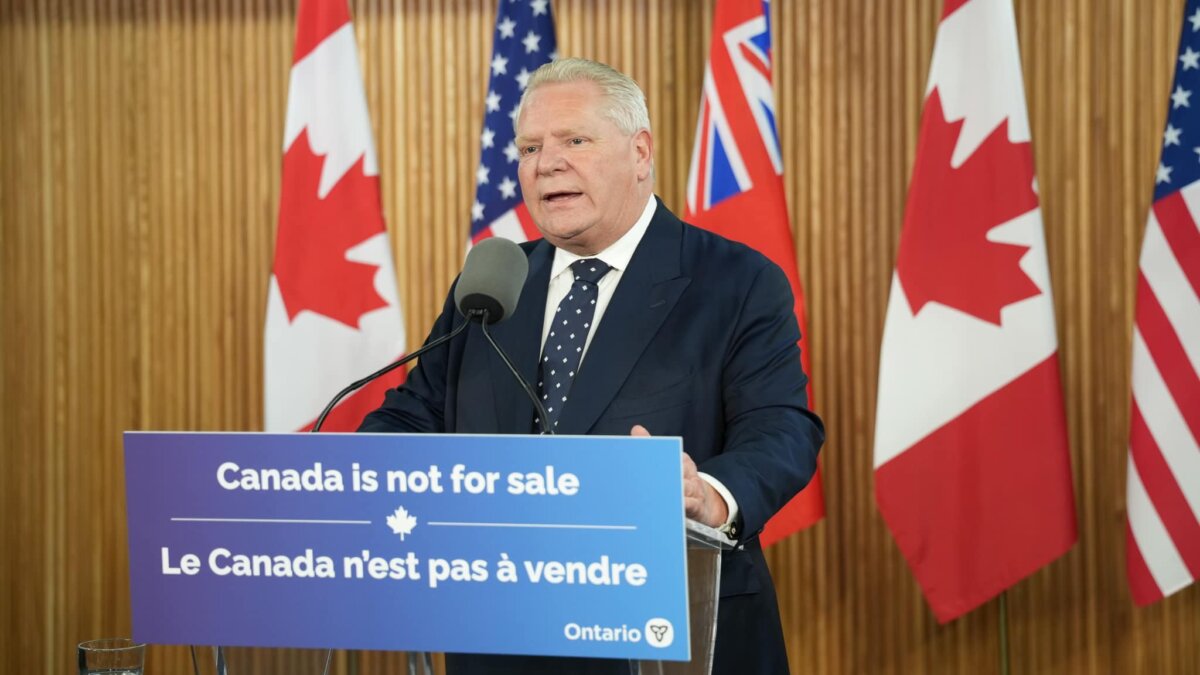
All American liquor products were removed from the shelves of LCBO stores across Ontario Tuesday morning. The province has also banned U.S.-based companies from bidding on Ontario’s $30 billion annual government procurement contracts and its $200 billion infrastructure projects. The province has terminated a $100-million satellite internet agreement with Elon Musk’s Starlink.
Ford says he plans to impose a 25% export surcharge on electricity supplied from Ontario to 1.5 million customers in New York, Michigan, and Minnesota if the tariffs persist.
Ontario Premier stated on X that he has written to the governors in New York, Michigan, and Minnesota emphasizing that it is his duty to protect Ontario and warns of economic repercussions, including job losses and higher prices for Americans.
Today, I wrote to the governors, senators and congressmen and women from New York, Michigan and Minnesota putting them on notice that Ontario is prepared to add a 25 per cent surcharge to the electricity we export to their states if President Trump’s tariffs remain in place.
If… pic.twitter.com/pQwCelzHNp
— Doug Ford (@fordnation) March 4, 2025
Ford warned that if tariffs increase, Ontario may further raise the surcharge or cut off power exports entirely. The premier has also signaled potential taxes or restrictions on rare earth mineral exports to the U.S.
Per Canadian Energy Regulator website, “provinces tend to import electricity if it is cheaper than generating it, if there is a generating shortfall, or if demand is higher than anticipated.” Between 2019 and 2024, Ontario companies paid an average of $57.15 per MWh to import wholesale electricity from the U.S., while the province exported electricity to the U.S. at an average wholesale price of $41.77 per MWh.
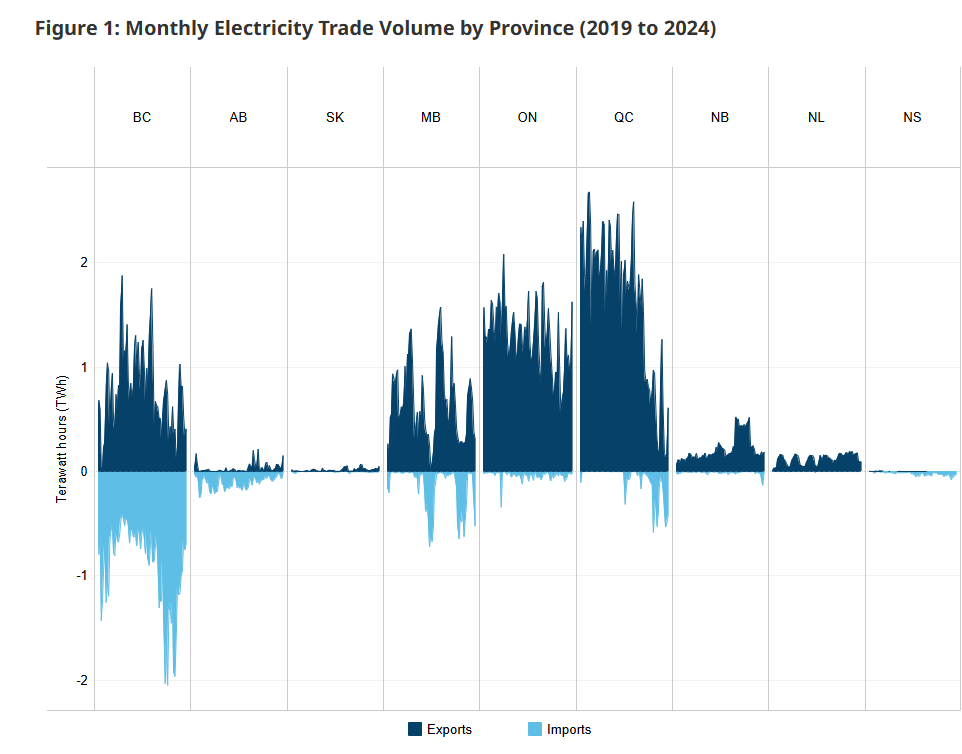
Monthly Electricity Trade Volume by Province (2019 to 2024)/Canada’s Energy Regulator
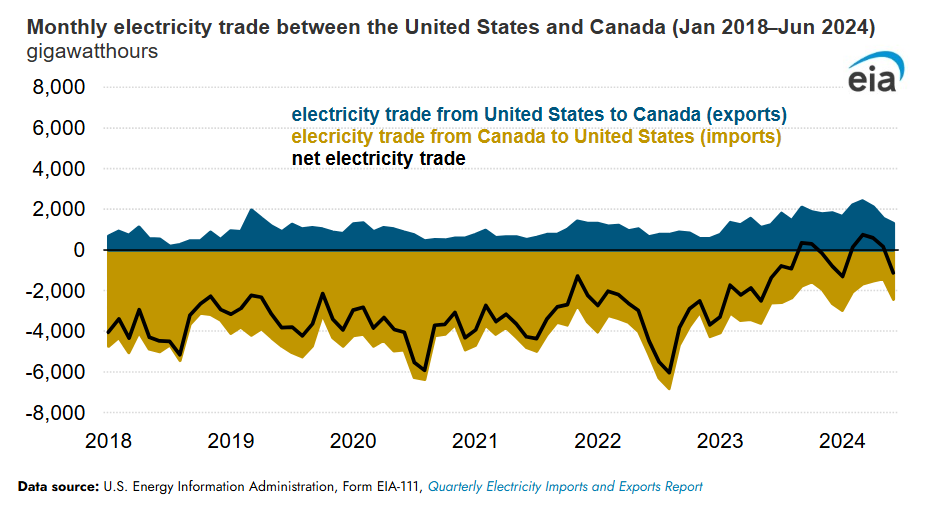
According to U.S. Energy Information Administration, the electricity trade between Canada and the U.S. became more balanced due to reduced Canadian hydropower generation from droughts and lower U.S. natural gas prices making American electricity more competitive.
U.S. exports to Canada surged by 70%, while Canadian exports dropped by 36%. By late 2023, the U.S. became a net electricity exporter for several months. The value of Canadian electricity sales to the U.S. fell 30% to $3.2 billion, while U.S. sales rose to $1.2 billion. Major power exchanges occur through interconnected grids, with regional variations affecting trade dynamics, particularly in the Western and Eastern Interconnections.
The United States is not heavily reliant on Canadian electricity for its overall energy needs, but the relationship is complex. In 2024, Canada supplied approximately 27.2 terawatt-hours (TWh) of electricity to the U.S., making up about 90% of total U.S. electricity imports. This power supports millions of homes, especially in border states like New York, Michigan, and Minnesota. However, despite Canada’s significant role as a supplier, these imports account for less than 1% of the U.S.’s total annual electricity consumption, which exceeds 4,000 TWh.


