Kelowna
U.S. President Donald Trump sharply criticized Canadian Prime Minister Mark Carney on Wednesday, responding directly to Carney’s remarks at the World Economic Forum in Davos that questioned the durability of the U.S.-led global order.
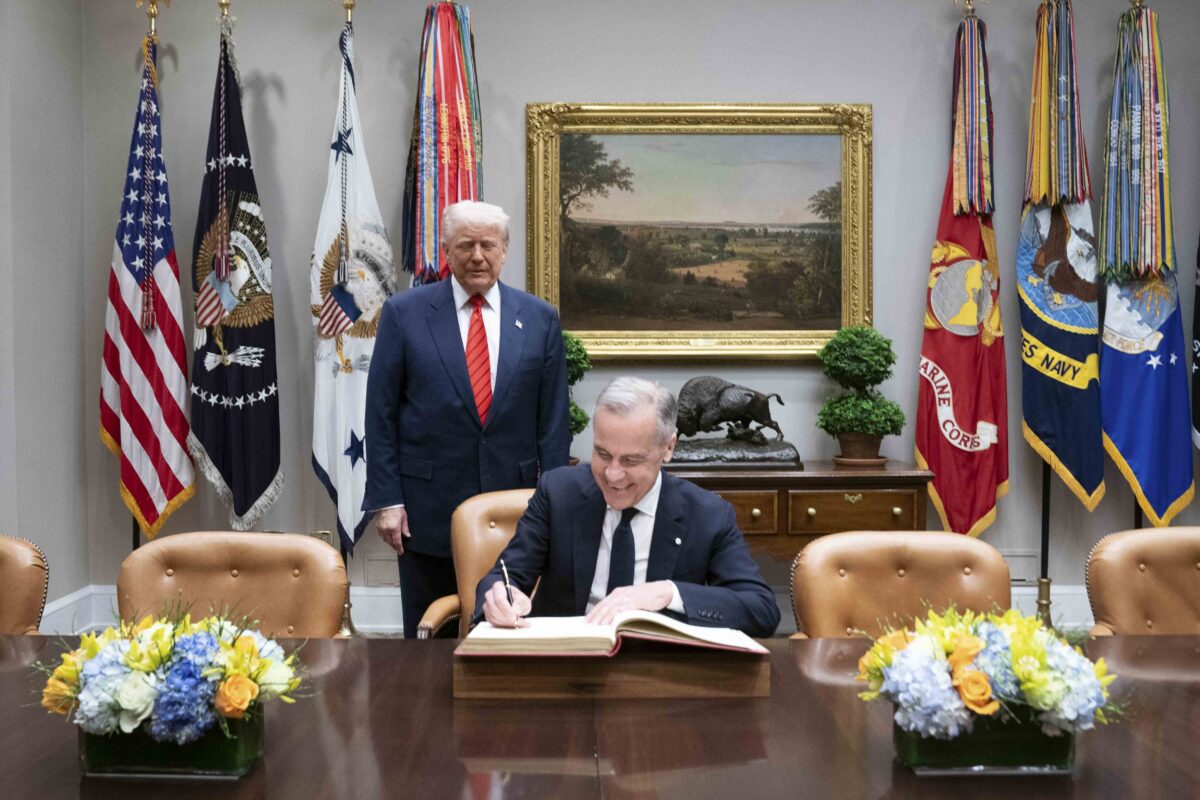
Prime Minister Mark Carney during a meeting with U.S. President Donald Trump at the White House in Washington, D.C., on May 6, 2025. Credit: PMO/ Lars Hagberg
Trump repeated his call for Denmark to allow the U.S. to annex Greenland and said he views the territory as strategically vital, partly because of his proposed Golden Dome missile defence system.
Trump said the Golden Dome would extend protection to Canada because of geography. He then turned his attention to Carney’s speech from the previous day.
“Canada gets a lot of freebies from us, by the way. They should be grateful, also, but they’re not. I watched your Prime Minister yesterday. He wasn’t so grateful,” Trump told the audience. He followed with a direct warning: “Canada lives because of the United States. Remember that, Mark, next time you make your statements.”
.@POTUS: “Canada gets a lot of freebies from us, by the way… I watched their prime minister yesterday he wasn’t so grateful… Canada lives because of the United States. Remember that, @MarkJCarney, the next time you make your statements.” 🔥🔥🔥 pic.twitter.com/ZFrcUN3ruj
— Trump War Room (@TrumpWarRoom) January 21, 2026
Speaking at the World Economic Forum on Tuesday, Prime Minister Mark Carney said Canada is navigating a global system undergoing a “rupture, not a transition,” as great powers increasingly act without restraint. He argued that the long-standing rules-based international order, underpinned largely by United States leadership, no longer functions as advertised, noting that economic tools such as tariffs, finance, and supply chains are now being used as instruments of coercion.
Carney acknowledged that American hegemony once provided stability through open sea lanes, financial systems, and collective security, but said that the bargain “no longer works.” He warned middle powers against “living within the lie” by accommodating stronger states in hopes of safety, saying compliance will not protect sovereignty.
Instead, he called for “values-based realism,” urging countries like Canada to diversify away from dependence on any single hegemon, including the U.S., while remaining principled. Canada, he said, is reducing vulnerability through trade diversification, stronger domestic capacity, and new partnerships, while opposing tariffs and economic intimidation. His message was clear: middle powers must act together, or risk being sidelined in a world dominated by great-power rivalry.