 Kelowna
An estimated 105,529 Canadians received non-emergency medical treatment outside the country in 2025, according to a new analysis by the Fraser Institute. The estimate follows the same methodology the institute has used since 2007 to track medical travel.

Because Canada does not maintain direct data on patients leaving the country for care, researchers relied on physician surveys from the institute’s Waiting Your Turn report and procedure data from the Canadian Institute for Health Information. Physicians across 12 medical specialties were asked what percentage of their patients had received non-emergency treatment abroad in the previous year.
In 2025, urologists reported the highest proportion of patients travelling abroad (3.7 per cent), while cardiovascular surgeons reported the lowest (0.9 per cent).
When those percentages were applied to national procedure volumes, researchers estimated tens of thousands of patients left the country for care. Ontario recorded the largest number of patients travelling abroad (26,513), while British Columbia had the highest provincial proportion (2.4 per cent).
Key findings include:
- 105,529 Canadians received non-emergency medical treatment outside Canada in 2025
- 10,320 patients travelled abroad for general surgery
- 12,697 patients sought urology treatment outside Canada
- 8,304 patients left for internal medicine procedures
- 6,482 patients travelled for ophthalmology care
- 477 patients received radiation oncology treatment abroad
Estimated number of patients that received treatment outside of Canada in 2025 (by province):
- Ontario: 51,538
- British Columbia: 25,698
- Alberta: 13,919
- Quebec: 6,285
- Saskatchewan: 1,852
- Nova Scotia: 1,820
- New Brunswick: 1,659
- Manitoba: 1,585
- Newfoundland and Labrador: 950
- Prince Edward Island: 222
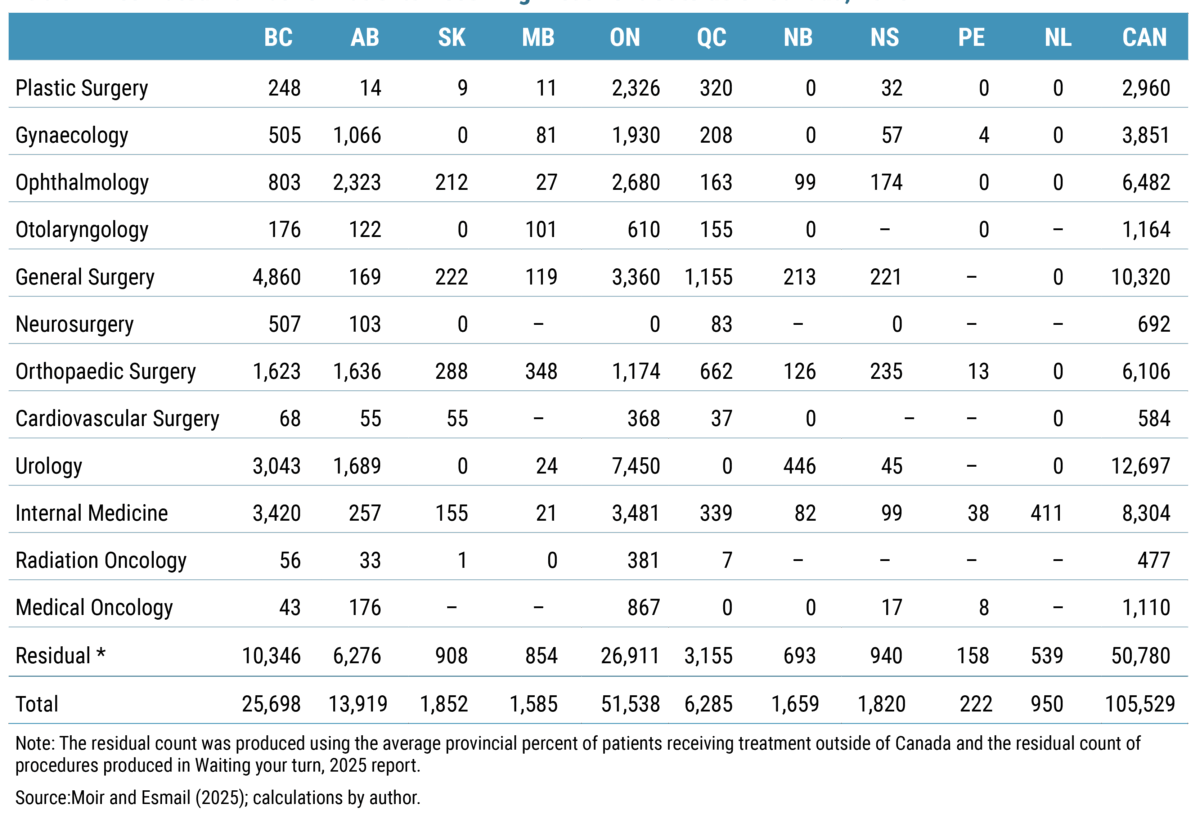
Credit: Estimated number of patients receiving treatment outside of Canada by specialty in 2025.
The report notes that long wait times may be a factor. In 2025, patients waited 13.3 weeks for treatment after seeing a specialist, nearly 4.5 weeks longer than what physicians consider reasonable.
Researchers caution that the estimate may be low, as it does not capture patients who left Canada without consulting a specialist.
Add as a trusted source on Google


