 Charlottetown
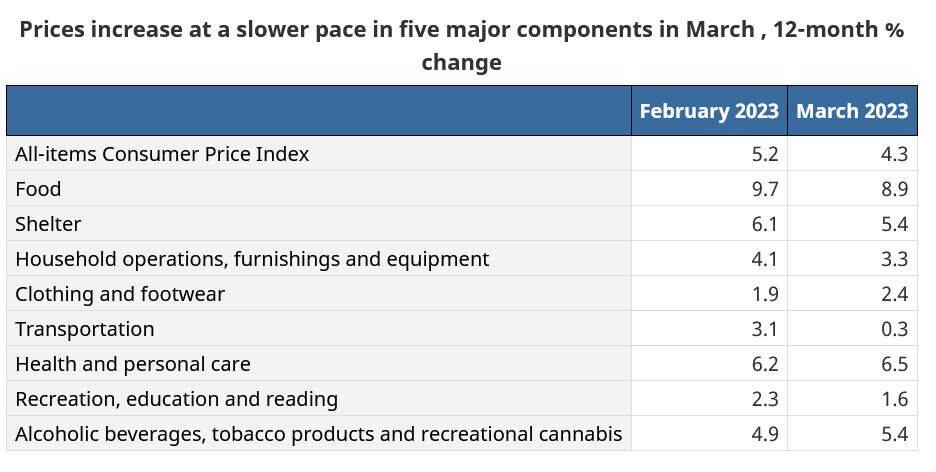
In March, the Consumer Price Index (CPI) rose 4.3% year over year, marking a deceleration from February’s 5.2% increase, says Statistics Canada in the Consumer Price Index report.
This was the smallest year-over-year increase since August 2021.
Per the report, the slower inflation rate was largely driven by a decline in energy prices, particularly gasoline, which fell 13.8% year over year due to steep price increases in March 2022 following Russia’s invasion of Ukraine.
Mortgage interest costs, on the other hand, increased as Canadians continued to renew and initiate mortgages at higher interest rates.
Credit: Statistics Canada
Statistics Canada says excluding food and energy, prices in March increased 4.5% year over year, while the all-items CPI excluding mortgage interest cost rose 3.6%. On a monthly basis, the CPI was up 0.5% in March, with travel tours contributing the most to the headline month-over-month movement due to increased seasonal demand during March break.
Price growth for durable goods, such as furniture and passenger vehicles, slowed down in March. Furniture prices fell 0.3% year over year, largely due to a base-year effect as prices rose 8.2% month over month in March 2022 amid supply chain issues.
Passenger vehicle prices increased at a slower pace year over year in March 2023 (+4.7%) compared to February (+5.3%), with new passenger vehicle prices up 1.3% month over month in March.
Homeowners’ replacement costs continued to slow, rising 1.7% year over year in March, while mortgage interest costs increased at the fastest pace on record (+26.4%). Grocery prices also increased at a slower pace, with food purchased from stores seeing a 9.7% rise in March compared to February’s 10.6% increase.
Inflation Across Provinces:
Credit: Statistics Canada
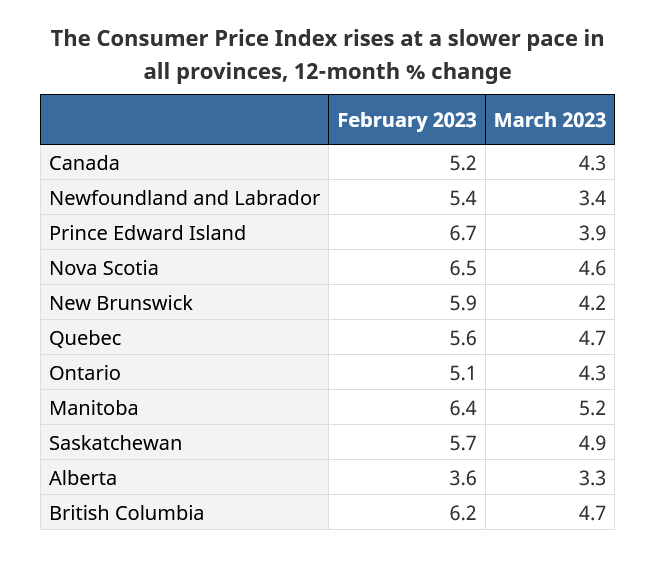
Across Canada, price growth slowed in every province, with the most significant slowdown occurring in Atlantic Canada due to lower fuel oil and other fuel prices.
Alberta has the lowest inflation at 3.3 %.
In Manitoba, rent prices increased 8.2% year over year, marking the fourth consecutive month of increases above 5% as rental demand continues to outpace supply amid population growth.


