 Kelowna
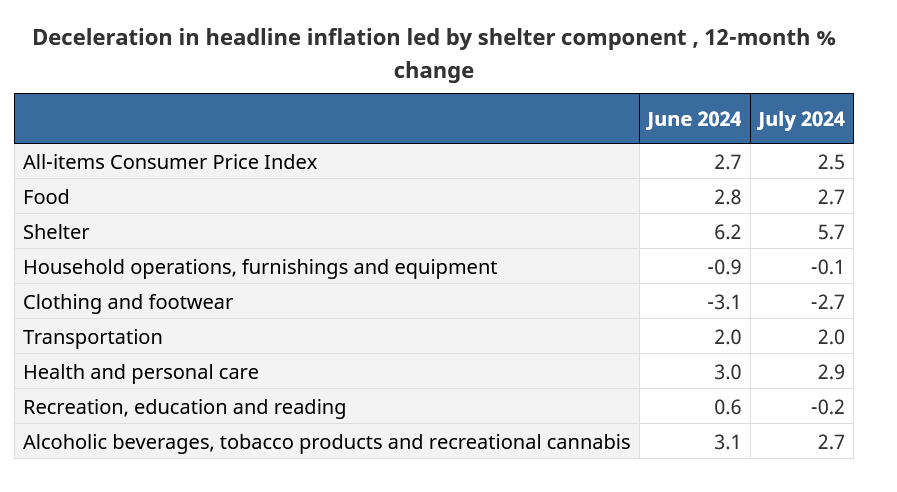
The Consumer Price Index (CPI) rose by 2.5% in June on a year-over-year basis, showing a decrease from the 2.7% increase in June.
According to Statistics Canada, this marks the slowest annual growth rate since March 2021. Reduced prices in travel tours, passenger vehicles, and electricity primarily drove the deceleration in inflation.
Here are the highlights of the monthly report from Statistics Canada:
-
- Year-over-Year CPI Growth: Increased by 2.5% in July, down from 2.7% in June.
- Monthly CPI Changes: Rose by 0.4% in July after a 0.1% decline in June. Seasonally adjusted, the CPI increased by 0.3%.
- Travel and Accommodation: Year-over-year decreases were noted in travel tours (-2.8%), traveller accommodation (-3.7%), and air transportation (-2.7%). Conversely, month-over-month, these categories saw increases: travel tours (+4.5%), air transportation (+8.4%), and traveller accommodation (+7.1%).
- Automobile Prices: Passenger vehicle prices fell by 1.4% year-over-year, with new vehicle prices rising only 1.0% and used vehicle prices decreasing by 5.7%.
- Fuel Costs: Gasoline prices increased by 1.9% year-over-year, with a notable rise in the Prairie provinces due to a refinery shutdown in the Midwestern United States.
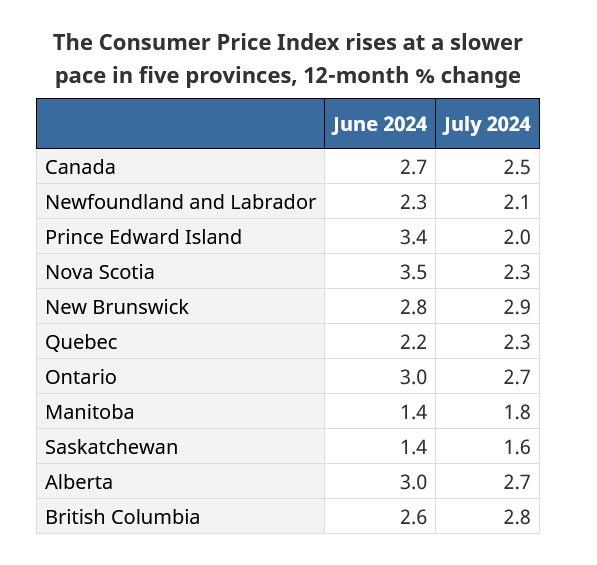
- Regional Price Variations: Slower price growth in July compared to June in five provinces, particularly in Prince Edward Island and Nova Scotia, mainly due to slower rises in gasoline and fuel oil prices.
- Shelter Costs: Year-over-year growth in shelter prices slowed to 5.7% in July from 6.2% in June. Specific factors include:
- Electricity Prices: Dropped by 0.8%, with a significant reduction in Alberta (-35.5%) due to last year’s high demand-driven price spikes.
- Mortgage Interest Costs: Increased by 21.0%, down from 22.3%.
- Rent: Rose by 8.5%, a slight deceleration from June’s 8.8% increase, with the most notable slowdowns in Prince Edward Island, Alberta, and New Brunswick.
- Fuel Oil and Other Fuels: Rose by 3.5%, a decrease from June’s 10.5% increase, affecting mainly Atlantic Canada.
These figures indicate a broad moderation in inflationary pressures across several key sectors in Canada for the month of July.
The measures of core inflation, CPI-trim and CPI-median, which the Bank of Canada uses as one of the factors to determine the interest rate, are reduced at a lower rate and hover around 2.7% and 2.4%, respectively, down from June figures of 2.8% and 2.6%.
CPI-trim and CPI-median are core inflation measures that exclude extreme price changes. CPI-trim removes the outer 40%, while CPI-median focuses on the median price change.
The next scheduled date for announcing the overnight rate target is Wednesday, September 4, 2024.


