Kelowna
Canada’s inflation pace eased in February, offering a slight breather for consumers after stronger price growth earlier in the year, says Statistics Canada.
Credit: Krish Parmar/Unsplash
According to the latest Consumer Price Index (CPI) data, prices rose 1.8% year over year in February 2026, down from 2.3% in January.
The slowdown wasn’t driven by sudden price drops across the board. Instead, much of it came from what economists call a base-year effect tied to the end of the GST/HST tax break in February 2025. That earlier tax change pushed prices up last year, making today’s annual comparison look softer.
Below are the key takeaways:
- Inflation slows as earlier tax effect fades: Canada’s CPI rose 1.8% annually in February, easing from 2.3% in January. A major factor was the fading impact of the GST/HST break, which ended February 15, 2025 and temporarily raised prices that month. As that spike dropped out of the annual comparison, headline inflation cooled. The CPI still rose 0.5% month-to-month and 0.1% on a seasonally adjusted basis.
- Restaurant meals still climbing: Even with the slowdown, some prices remain stubbornly high. Restaurant food prices increased 7.8% year over year, though the tax-related base effect reduced the pace of growth. Similar downward pressure showed up in store-bought alcohol (+5.6%), alcohol served in bars and restaurants (+6.8%), and toys and hobby supplies (+5.4%), which were also affected by last year’s tax changes.
- Energy prices pulling inflation down: Falling energy costs were among the strongest downward forces. Gasoline prices dropped 14.2% annually, while natural gas fell 17.1%. Other declines included homeowners’ replacement costs (-2.1%), other owned accommodation expenses (-2.6%), and travel tours (-3.1%), all helping to keep overall inflation lower.
- Grocery prices still rising, but slower: Grocery inflation moderated slightly. Food purchased from stores rose 4.1% year over year, down from 4.8% in January. Beef prices led the slowdown, increasing 13.9%, compared with 18.8% the previous month. Despite easing growth, grocery prices remain significantly higher overall — up 30.1% since February 2021.
- Cellphone plans cheaper, gas rising monthly: Some monthly changes stood out. Cellular service prices rose 1.5% year over year, slower than January’s 4.9%, after a 3.3% monthly drop driven by cheaper wireless plans. Gasoline, meanwhile, rose 3.6% month over month. In British Columbia, prices jumped 9.6%, largely due to refinery maintenance and tighter fuel supply.
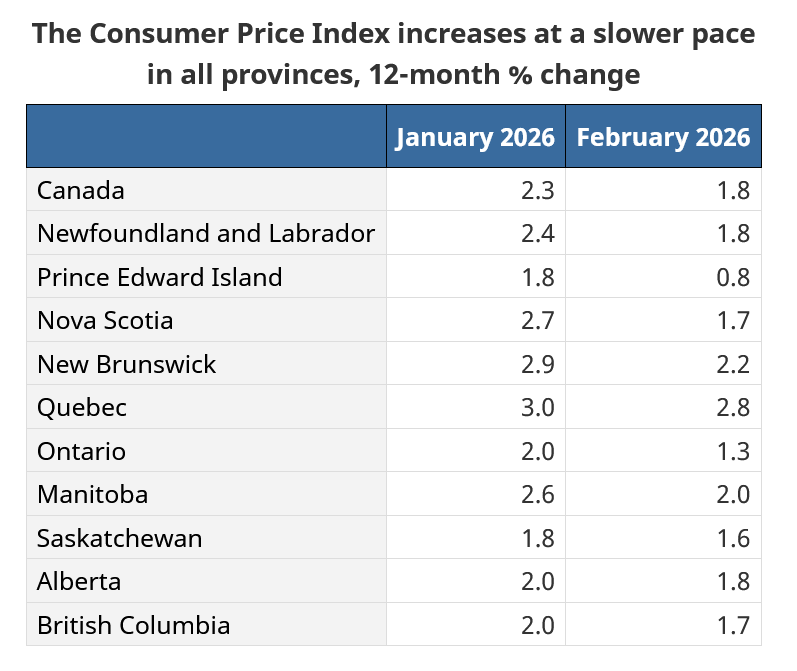
- Regional inflation slowing across Canada: Price growth slowed in every province compared with January. Ontario’s inflation eased to 1.3%, while Quebec recorded 2.8%. Atlantic provinces saw sharper slowdowns partly because the earlier HST tax break had a larger impact there. Prince Edward Island posted the lowest annual inflation at 0.8%.
Statistics Canada says March 2026 will be the last month affected by the base-year impact from the 2025 tax break.