 Winnipeg
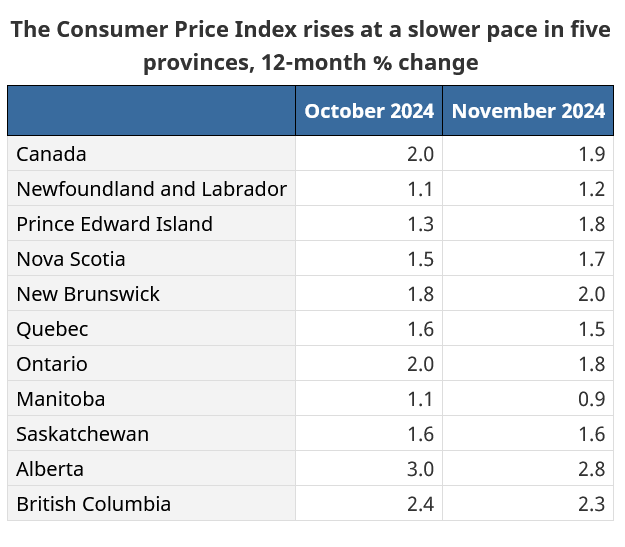
Inflation increased by 1.9% year-over-year in November 2024, down slightly from October’s 2.0% rise, according to Statistics Canada’s monthly report of the Consumer Price Index.
The slowdown was driven by reduced price growth in travel tours and mortgage interest costs. Excluding gasoline, the all-items CPI rose 2.0%, compared to 2.2% in the previous month.

On a monthly basis, the CPI remained unchanged, following a 0.4% increase in October. When seasonally adjusted, the monthly CPI rose by 0.1%.
Here are the highlights from the monthly report by Statistics Canada:
- Gasoline Prices: Gasoline prices fell 0.5% year-over-year, moderating from a 4.0% decline in October. This was largely due to a base-year effect. Monthly gasoline prices remained stable.
- Shelter Costs: The shelter index increased 4.6% annually, slowing from 4.8% in October. Rent prices rose 7.7% year-over-year, with the largest increases in Manitoba (+7.9%), Ontario (+7.4%), and Nova Scotia (+6.4%). Meanwhile, mortgage interest costs continued to decelerate, rising 13.2%, down from October’s 14.7%.
- Black Friday Discounts: Sales during Black Friday contributed to monthly price declines:
- Household operations, furnishings, and equipment fell 0.9%, driven by cellular services (-6.1%) and furniture (-2.1%).
- Clothing and footwear dropped 0.8%, with children’s clothing prices falling 4.9%, the largest November decline on record.
- Travel Services: Travel service prices fell 6.7% year-over-year, compared to a 7.1% decline in October. Higher costs for traveller accommodation (+8.7%) drove this trend, particularly in Ontario, where hotel prices rose 23.7% annually. Monthly accommodation prices in Ontario climbed 11.0%, coinciding with notable concerts. Travel tour prices fell further, down 12.0% annually.
- Provincial Highlights: Price growth slowed in five provinces, while Atlantic Canada saw an acceleration due to fuel oil costs, commonly used for home heating in the region.
-
-
- Price growth eased in Ontario (2.0% to 1.8%), Quebec (1.6% to 1.5%), Manitoba (1.1% to 0.9%), Alberta (3.0% to 2.8%), and British Columbia (2.4% to 2.3%).
- In contrast, New Brunswick saw an acceleration from 1.8% to 2.0%. Other provinces recorded slight increases, such as Prince Edward Island (1.3% to 1.8%) and Nova Scotia (1.5% to 1.7%). Newfoundland and Labrador rose to 1.2%. Saskatchewan remained unchanged at 1.6%.
-
The measures of core inflation, CPI-trim and CPI-median, which the Bank of Canada uses as one of the factors to determine the interest rate, are nudged higher and hover around 2.7% and 2.6%, respectively.
CPI-trim and CPI-median are core inflation measures that exclude extreme price changes. CPI-trim removes the outer 40%, while CPI-median focuses on the median price change.


