Regina
Limit alcoholic drinks to no more than two standard drinks a week says Canadian Centre on Substance Use and Addiction (CCSA) in its latest guidelines.

Credit: Alexandra K/Unsplash
The centre released the updated Canada’s Guidance on Alcohol and Health since the first Low-Risk Alcohol Drinking Guidelines (LRDGs) was published in 2011.
CCSA’s 2011 guidelines allowed no more than 10 standard drinks a week for women, with no more than two drinks a day most days, and 15 standard drinks a week for men, with no more than two drinks a day most days to avoid that long-term health risk due to drinking.
A standard drink in Canada is 17.05 ml or 13.45 grams of pure alcohol, which is equivalent to:
- A bottle of beer (12 oz., 341 ml, 5% alcohol)
- A bottle of cider (12 oz., 341 ml, 5% alcohol)
- A glass of wine (5 oz., 142 ml, 12% alcohol)
- A shot glass of spirits (1.5 oz., 43 ml, 40% alcohol)
The latest Low-Risk Alcohol Drinking Guidelines recommend the risk thresholds for alcohol use should be set at either two or six standard drinks per week respectively, for both females and males in Canada.
According to CCSA, 3 to 6 standard drinks a week represent a moderate risk to your health and further alcohol consumption increase your risk of seven types of cancer, most types of cardiovascular diseases, liver disease and violence.
CCSA now recommends Canadians consider reducing their alcohol use to the following to reduce the risk of harm from alcohol:
- Low risk: 1 to 2 standard drinks per week
- Moderate risk: 3 to 6 standard drinks per week
- High risk: 7 or more standard drinks per week
- No matter where you are on that continuum of alcohol use, for your health, less is better.
- If you’re going to drink, don’t exceed more than 2 drinks on any day.
- When pregnant or trying to get pregnant, there is no known safe amount of alcohol.
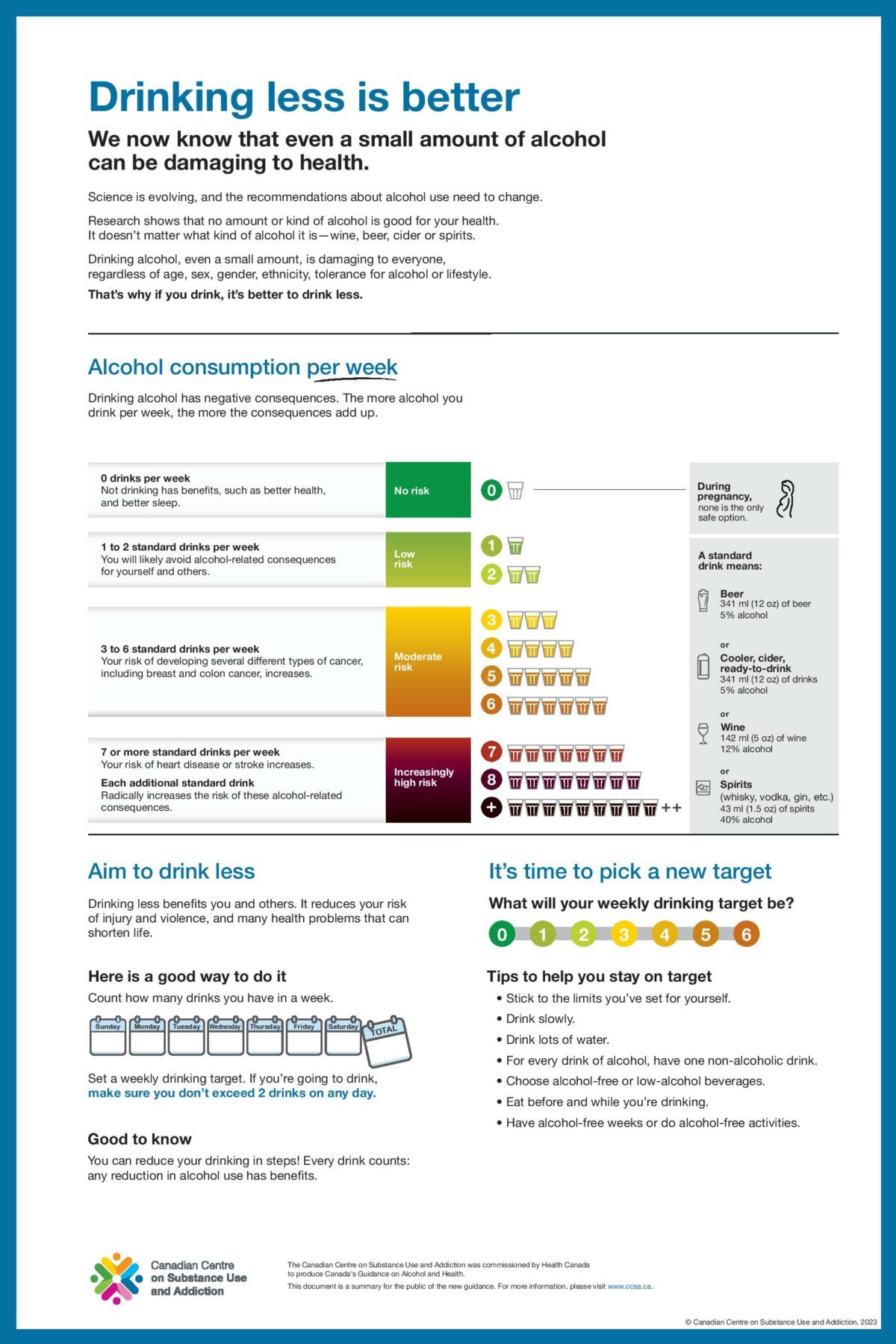
Credit: CCSA
The new recommendations are based on a two-year research project, led by CCSA which looked at nearly 6,000 peer-reviewed studies and involved an expert panel of 23 scientists representing 16 organizations.
The guidelines also incorporated findings from focus groups and three consultations with the public and stakeholders.
The detailed report is available here – Update of Canada’s Low-Risk Alcohol Drinking Guidelines