 Vancouver
For Canadians who needed medical care this year, the Fraser Institute’s latest report on healthcare wait times in Canada likely confirms their experiences.
Fraser Institute
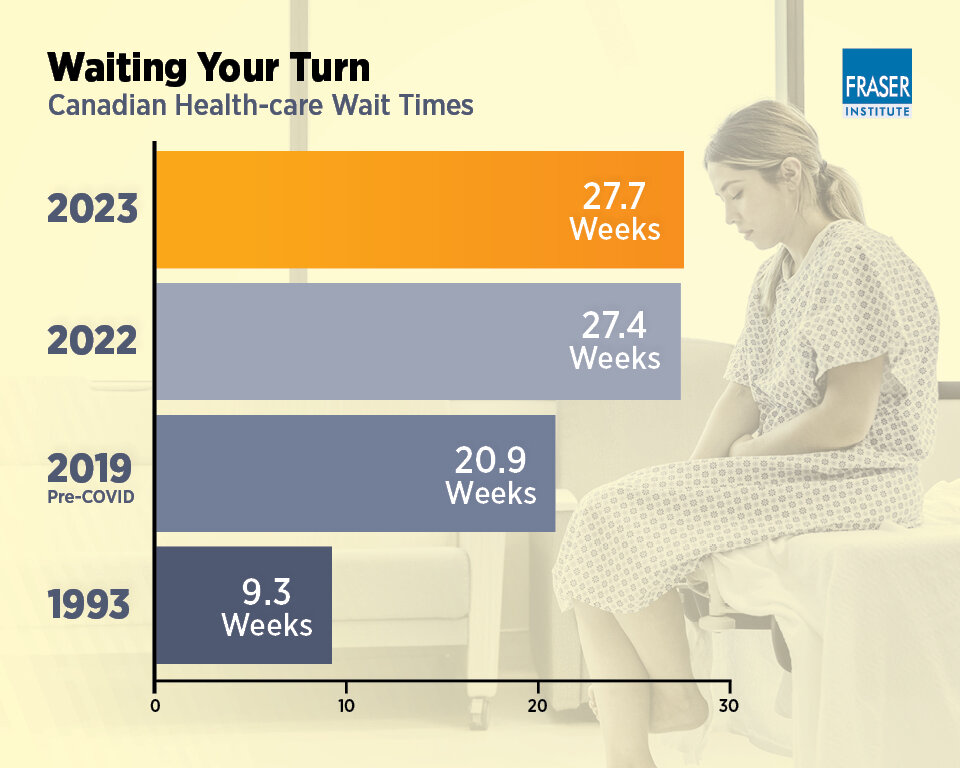
The median wait time for treatment in Canada for the year 2023 was 27.7 weeks, an increase from previous years — 27.4 weeks in 2022 and 25.6 weeks in 2021.
This duration marks a staggering 198% increase from the 9.3-week wait experienced in 1993.
The findings are highlighted in the 2023 “Waiting Your Turn: Wait Times for Health Care in Canada” report by the Fraser Institute, an independent, non-partisan Canadian public policy think tank. This year’s survey, involved physicians from twelve specialties across ten provinces. The record-breaking wait time of 27.7 weeks is from a general practitioner’s referral to treatment. Fraser Institute has been studying wait times across Canada by surveying specialist physicians across 12 specialties and ten provinces since 1993.
Fraser Institute collected data from physicians for the study between January 16 and July 1, 2023. The organization received 1,269 responses across 12 specialties. The response rate was 10.3% – a lower response rate than in some previous years – and as a result, the authors say the findings in this report should be interpreted cautiously.
The report splits the wait times into two parts – referral by a general practitioner to consultation with a specialist and from the consultation with a specialist to the point at which the patient receives treatment.
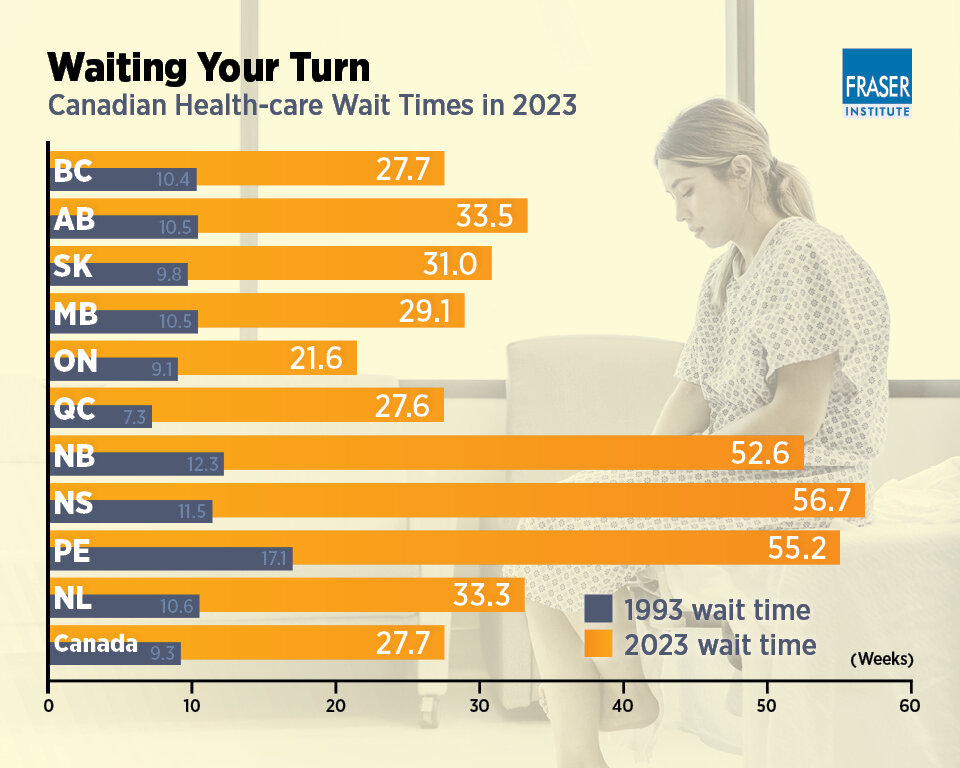
In 2023, Ontario experienced the shortest overall wait time in Canada at 21.6 weeks, with Quebec (27.6 weeks) and British Columbia (27.7 weeks) closely following. Conversely, Nova Scotia faced the lengthiest wait at 56.7 weeks, succeeded by Prince Edward Island at 55.2 weeks and New Brunswick at 52.6 weeks.
Wait times:
Fraser Institute/Waiting Your Turn 2023
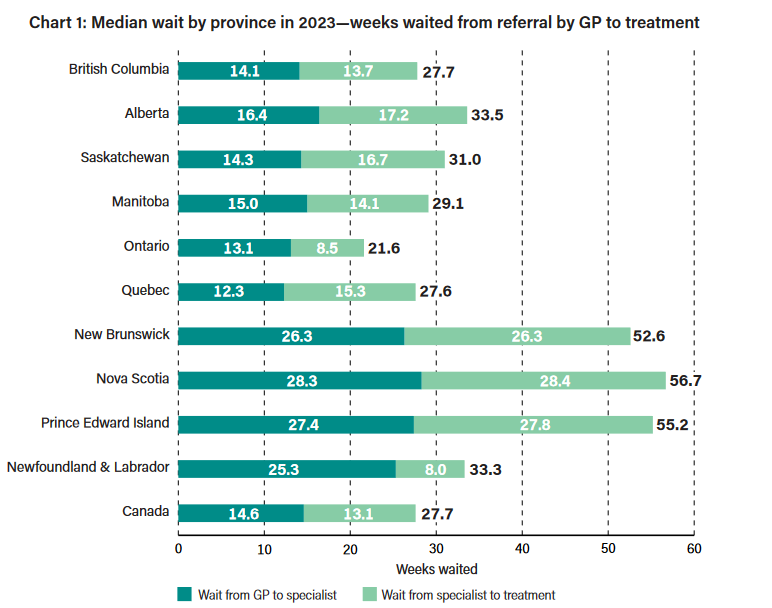
The wait from a general practitioner’s referral to a specialist consultation increased from 12.6 weeks in 2022 to 14.6 weeks in 2023. Seven provinces experienced an increase in waiting times compared to 2022, but Manitoba, Nova Scotia, and Prince Edward Island saw decreases.
Quebec (12.3 weeks), Ontario (13.1 weeks), and British Columbia (14.1 weeks) had the shortest wait times for specialist consultations. Conversely, the longest waits were observed in Nova Scotia (28.3 weeks), Prince Edward Island (27.4 weeks), and New Brunswick (26.3 weeks).
The second segment, from specialist consultation to treatment, saw a decrease from 14.8 weeks in 2022 to 13.1 weeks in 2023. However, this is still 133% longer than the 5.6-week wait in 1993 and exceeds the clinically “reasonable” wait time of 8.5 weeks. Newfoundland & Labrador experiences the shortest wait in this category (8.0 weeks), with Nova Scotia again reporting the longest (28.4 weeks).
Surgery/Speciality Wait Times:
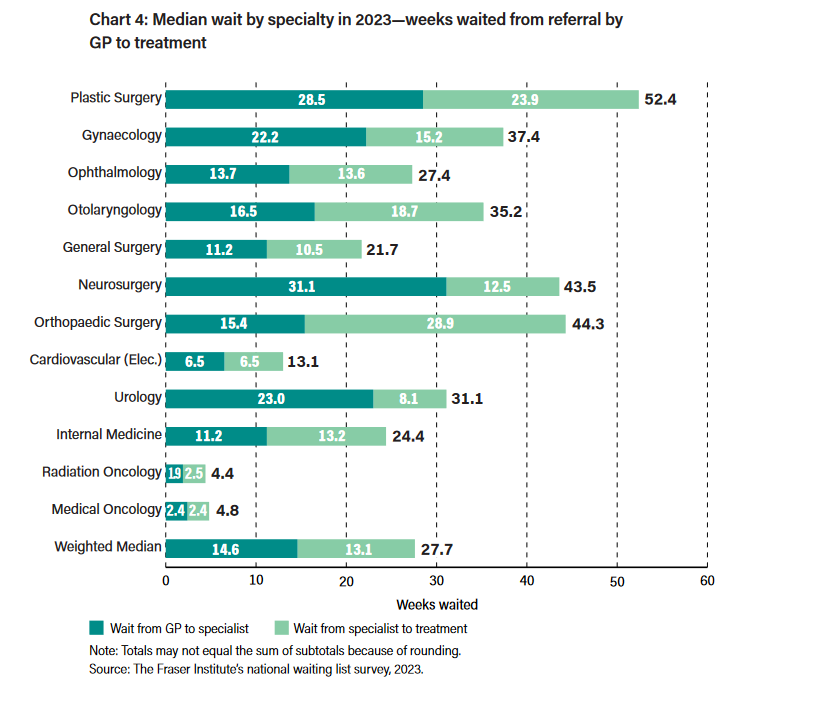
Among the various specialties, the shortest wait times between a referral by a GP referral to a specialist in 2023 were for radiation oncology (4.4 weeks), medical oncology (4.8 weeks), and elective cardiovascular surgery (13.1 weeks).
In contrast, the longest waits were for plastic surgery (52.4 weeks), orthopedic surgery (44.3 weeks), and neurosurgery (43.5 weeks).
Fraser Institute/Waiting Your Turn 2023
Diagnostic wait times:
Diagnostic technologies also see considerable wait times. Canadians can expect to wait 6.6 weeks for a CT scan, 12.9 weeks for an MRI scan, and 5.3 weeks for an ultrasound.
Quebec has the shortest wait at 4.0 weeks, and Nova Scotia has the longest at 14.0 weeks.
MRI scan waits also increased, reaching 12.9 weeks, up from 10.6 weeks the previous year. Ontario and Quebec reported the shortest MRI waits at 10.0 weeks, while Nova Scotia had the longest at 25.0 weeks.
Ultrasound wait times grew to 5.3 weeks in 2023, up from 4.9 weeks in 2022, with Saskatchewan offering the shortest wait at 2.0 weeks and Prince Edward Island the longest at 14.0 weeks.
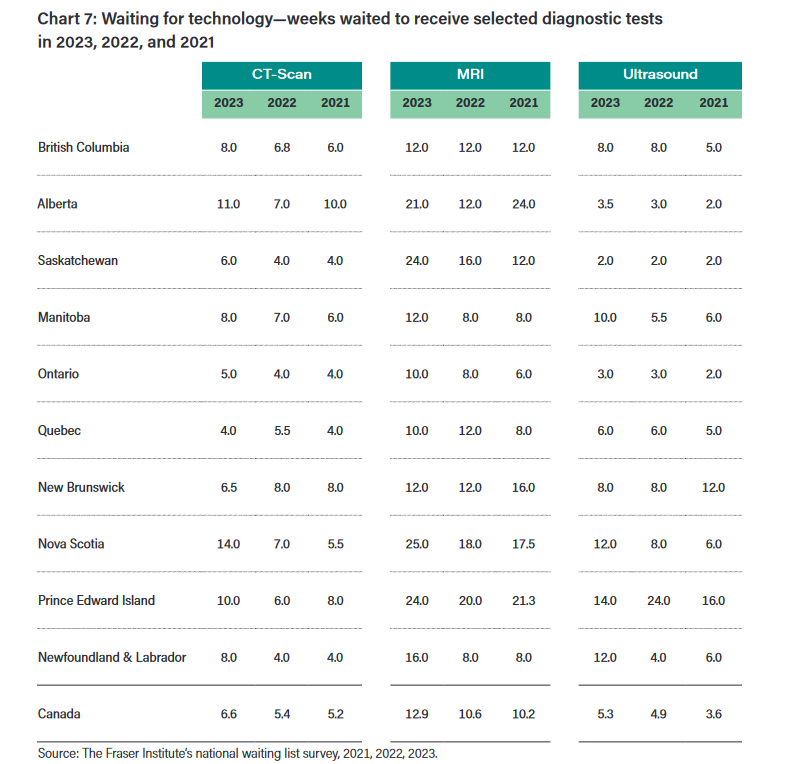
Fraser Institute/Waiting Your Turn 2023
Across the ten provinces, about 1,209,194 procedures had patients waiting in 2023, meaning 3% of Canadians are awaiting treatment. The proportion of those waiting varies, with Ontario having the lowest (2.14%) and Nova Scotia the highest (8.39%). Notably, only 13.7% of patients are on waiting lists due to their own requests for delays.
“Excessively long wait times remain a defining characteristic of Canada’s health-care system,” said Mackenzie Moir, Fraser Institute policy analyst and study co-author releasing the annual report.
“And they aren’t simply minor inconveniences, they can result in increased suffering for patients, lost productivity at work, a decreased quality of life, and in the worst
cases, disability or death.”
A detailed report is given here — Waiting Your Turn: Wait Times for Health Care in Canada, 2023 Report.


