Winnipeg
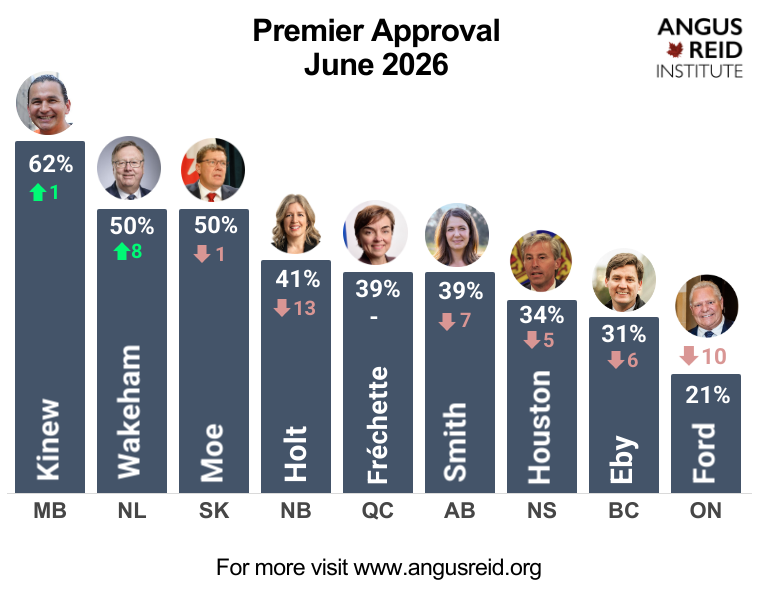
Three of Canada’s most visible premiers are now facing their weakest approval numbers to date, according to new Angus Reid Institute polling.

Danielle Smith in Alberta, David Eby in British Columbia, and Doug Ford in Ontario have each fallen to personal lows, though the reasons differ province by province. The Angus Reid Institute surveyed 1,803 Canadian adults online from May 7 to 11, 2026. Provincial margins of error range from plus or minus three to seven percentage points.
Here are the highlights of the quarterly poll:
Credit: Angus Reid
- David Eby, British Columbia: Eby is down to 31 percent, also a personal low. His government is under pressure over Indigenous rights and title, private-property concerns, DRIPA, health care and affordability. The arrival of Kerry-Lynne Findlay as BC Conservative Party leader also gives Eby’s opposition a clearer public face.
- Danielle Smith, Alberta: Smith has fallen to 39 per cent approval, her lowest mark yet. The slide comes as her government prepares an Oct. 19 referendum asking whether Alberta should remain in Canada or begin the legal process toward a future binding vote on separation. Smith says she does not support Alberta leaving Canada, but critics argue that the referendum lends separatism greater legitimacy. Among Albertans overall, 56 per cent disapprove of her performance, including 46 per cent who strongly disapprove.
- Scott Moe, Saskatchewan: Moe sits at 50 per cent approval, a steady result as he prepares to lead the Saskatchewan Party into the 2028 election. His government has faced criticism over its court-ordered addictions treatment legislation.
- Wab Kinew, Manitoba: Kinew remains the country’s most approved-of premier, with 62 per cent approval. He publicly challenged Smith on Alberta’s referendum stance and rejected enthusiasm around a proposed large-scale data centre in Manitoba.
- Doug Ford, Ontario: Ford’s approval has dropped to 21 per cent, the weakest point of his eight-year premiership. His government has tried to focus attention on protecting Ontario from U.S. tariffs, but that message has been weighed down by projected deficits, health-care pressure, affordability concerns and backlash over the short-lived purchase of a $28.9-million government jet.
- Christine Fréchette, Quebec: Fréchette begins with 39 per cent approval, a clear improvement over François Legault’s final 26 per cent. She has reopened debate around shale gas while cutting some taxes and fees tied to affordability.
- Tim Houston, Nova Scotia: Houston has slipped to 34 per cent, a new low. His government is still dealing with fallout from the spring budget, an eight-week long-term care strike and controversy over natural gas fracking consultations.
- Susan Holt, New Brunswick: Holt’s approval has fallen 13 points to 41 per cent. A record deficit budget, higher health-care spending and a planned highway toll near Nova Scotia have all drawn attention during her first stretch in office.
- Tony Wakeham, Newfoundland and Labrador: Wakeham rises to 50 per cent approval after moves aimed at the cost of living. His government pledged to make a gas tax cut permanent and pushed for relief on expected power-rate increases.
Per Angus Reid, results for Prince Edward Island were not released because its small population makes it difficult to draw discrete samples over multiple waves.